








 Lead Times
  No Sales Tax
  Made in USA
 20 mil floor / 20 mil wall
A common complete-liner choice when the same 20 mil vinyl weight is selected for the wall and floor.
Mil vs. gauge
Finding the right liner for your pool is difficult enough without having to decode the thickness of the vinyl. Mil and gauge are both used in liner descriptions, but they do not always mean the same thing.
What it means
Most pool professionals cannot tell you the official difference between vinyl gauge and mil measurements. In industries like wire, shotgun barrels, sheet metal, and hypodermic needles, the thickness or diameter increases as the gauge decreases. For sheet vinyl used in pool liners, and for photographic film, the thickness of the material increases as the gauge increases.
For liner ordering, the practical question is simpler: how thick is the vinyl in standard units? Ameri-Brand researched mil and gauge standards and compiled information from manufacturers across the vinyl industry so the common liner sizes can be compared side by side.
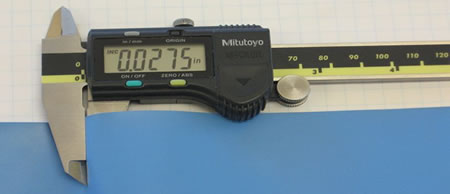
Thickness comparison
The values below are average measurements from vinyl samples provided by multiple liner manufacturers and vinyl suppliers. Each common liner thickness listed here is thinner than a dime.
| Common liner units | Average thickness | ||
|---|---|---|---|
| Mil | Gauge | Inches | Millimeters |
| - | 30 | 0.0260 | 0.6604 |
| - | 25 | 0.0223 | 0.5652 |
| - | 20 | 0.0185 | 0.4699 |
| 20 | - | 0.0205 | 0.5207 |
| 25 | - | 0.0250 | 0.6350 |
| 27 | - | 0.0270 | 0.6858 |
| 30 | - | 0.0275 | 0.6985 |
| 40 | - | 0.0405 | 1.0287 |
| Dime, for comparison | 0.0490 | 1.2446 | |
Averages are based on multiple measurements taken from vinyl samples provided by multiple liner manufacturers and vinyl suppliers.
Choose the liner section that matches your project, then use the quote flow to compare available patterns and thickness choices.