












 Lead Times
  No Sales Tax
  Made in USA
 Dome Pressure Switch Troubleshooting
Please take a few minutes to review the following.
Conditions That Can Lead to Air Loss
- On brand new installations (where the dome has been up for 3 days or less), the interior air flap has not yet had adequate time to conform to the deck and create a sufficient air seal.
- Pool water is not yet up to normal operating temperature.
- The excessive loss of air through deck drains, pool water level overflow drains, automatic pool cover sumps, or other areas where air might escape from the dome.
Air Pressure Switch Basics
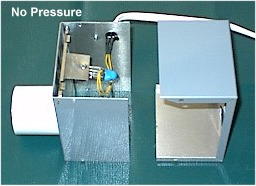
Example 1: On Position
When the aluminum flap is hanging completely vertical, there is no air moving through the white PVC tube. The dome is probably resting on the water at this point.
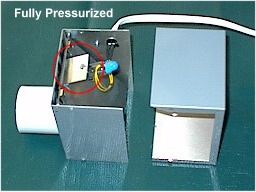
Example 2: Off Position
As the air pressure increases within the dome, the bottom of the hinged air flap moves back to the rear of the housing.
Please Note: With the switch properly set up (with the back of the switch in place) and looking through the large hole in the back of the switch at the bottom, you should note the following:
A. The air flap, or pressure plate, will remain motionless until there is adequate pressure to make it swing to the rear of the box. This is a sudden motion. As this happens, the back of the glass bulb will strike the top of the metal housing. This causes a “jarring” action which, combined with the change in angle of the glass bulb, causes the mercury to flow to the front end of the glass bulb, breaking contact and consequently turning the blower off (see picture). Again, if you do not witness this action, the dome is not getting to pressure and air loss is the most likely culprit.
B. Once the switch has turned off and as air pressure decreases, the pressure plate will begin to swing forward slowly (unlike the manner in which it swings to the rear). Once the pressure plate swings fully to the vertical position (Example 1), the mercury will flow to the rear of the glass tube, establish contact, and activate the blower. Once the pressure plate has slowly moved toward the front of the housing, the final ±3/8" of the travel will be “free fall,” causing the pressure plate to strike the front of the box, which also facilitates “jarring” the mercury and causing it to flow to the rear of the glass tube.
Again: field adjustments, i.e. changing the angle of the mercury switch, are a last-resort adjustment.
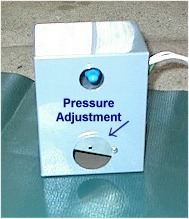
Making Adjustments
Slide the disc upward to DECREASE the pressure of the dome.
Slide the disc downward to INCREASE the pressure in the dome.
During Adjustments: Door should always remain all the way open except when increasing pressure due to high wind conditions.
Need More Information?
Please don’t hesitate to contact us for additional tech support.